
AI is Saving Lives
AI is already saving lives by improving diagnostics, accelerating drug discovery, and enhancing doctor accuracy.

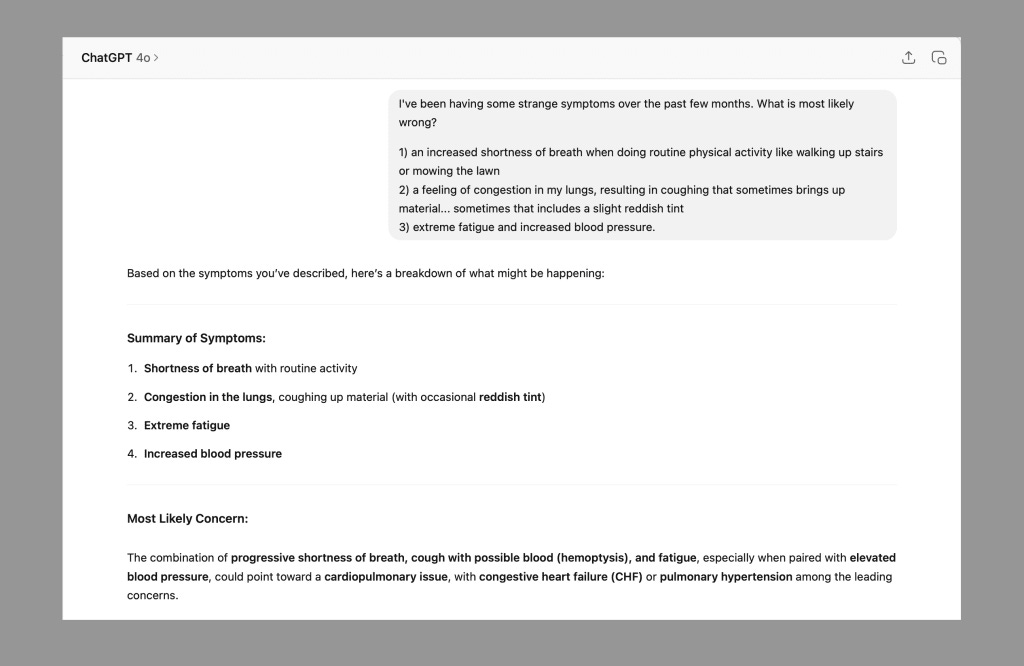
The use of artificial intelligence is already transforming healthcare. For patients, AI is empowering patients to learn about their health and make more informed decisions before and after seeing medical professionals. For doctors, AI enables them to manage data and administrative work so that they can spend more time focused on patients, as well as aiding them in treatment. Doctor-AI collaboration produces substantially more accurate diagnoses than humans alone.1 In science, AI is accelerating drug development and reducing costs.2
How is AI already saving lives?


More Examples
Mom uses ChatGPT to diagnose son’s rare condition after 17 doctors failed
After three years of seeing 17 different specialists who couldn’t explain her son Alex’s chronic pain, a mother fed his symptoms into ChatGPT. The AI suggested “tethered cord syndrome,” which a neurosurgeon later confirmed. Alex underwent surgery and is finally recovering.
Woman uses ChatGPT to diagnose rare disease after being dismissed by doctors
Lauren Bannon spent months being told her symptoms were just acid reflux, but her own research with ChatGPT pointed toward a thyroid issue. She insisted on a specific test the AI suggested, which revealed two cancerous lumps. She was able to have life-saving surgery because she caught the cancer early.
AI tool helps doctors detect “silent” heart attacks
This AI analyzes ECGs to find subtle signs of a totally blocked artery that human doctors often miss. In one case, it flagged a patient whose heart scan looked normal to the naked eye, getting them into emergency surgery just in time. This technology is now being used in ERs across the country to prevent permanent heart damage.
AI helps doctors identify a rare, life-threatening condition in minutes
A teenage girl with a mysterious, rapidly failing immune system left experts at multiple hospitals stumped. By using an AI model to cross-reference her rare symptoms, doctors were able to identify the exact disorder and start treatment immediately. The AI’s speed prevented her condition from becoming fatal.
AI tool helps find life-saving medicine for rare disease
A patient with a deadly immune disease was heading to hospice because no known treatments worked. An AI screened 4,000 existing drugs and discovered that a common arthritis medication was the perfect match for his case. The patient is now in full remission thanks to the AI’s repurposing of that drug.
A woman received treatment after using AI when her doctor didn’t answer
Bethany Crystal noticed red spots on her legs and shared her lab results with ChatGPT after her doctor’s office didn’t call back. The AI warned her that her platelet count was dangerously low and she needed to go to the ER immediately, where she received a life-saving blood transfusion for a rare disorder.“Human–AI collectives make the most accurate medical diagnoses,” Max-Planck-Gesellschaf.
OpenAI has documented the many ways that their AI tools have empowered patients and doctors:
Coordinating urgent care across the world
A San Francisco resident used ChatGPT to assess her mother’s sudden vision loss in Indonesia. The AI warned it could be a hypertensive crisis, prompting immediate testing and hospital care that helped restore most of her vision.Challenging an insurance denial
A Seattle patient with a rare autoimmune disease used ChatGPT to compile medical research and draft an appeal after his insurance denied a recommended therapy. The appeal succeeded and he gained approval for the treatment.Helping a rural doctor focus on patients
A physician in rural Montana uses an AI-powered clinical assistant to draft notes and handle documentation. The tool saves time on administrative work, allowing more attention for patients.Identifying new uses for existing drugs
Researchers used GPT-5 Pro to analyze a rare allergy case and suggest dupilumab, an eczema drug, as a potential treatment. The AI connected immune-system evidence that supported further research.Accelerating biotech research
A biotech startup uses ChatGPT alongside genomics tools to identify gene targets for diseases like Parkinson’s. The AI helped narrow dozens of candidates to a small set now being tested.Speeding up neuroscience research
A neuroscience PhD student uses ChatGPT to generate code for analyzing large brain datasets. Tasks that once took days can now be completed in minutes.Training the next generation of clinicians
A Stanford platform uses OpenAI’s API to simulate patient interactions so students can practice clinical reasoning. The system lets learners run through realistic cases and receive feedback.