
Jobs & Economy
Claims that AI threatens economic stability ignore its role in driving productivity gains, GDP expansion, stock market resilience, and U.S. international competitiveness amid global challenges.

Has AI shrunk the job market?
Leading labor research finds no measurable increase in unemployment or broad job displacement from AI1
New business formations and job postings for software engineers are increasing, not decreasing.2
Worsening employment for young workers started well before the advent of ChatGPT3
Historical precedent indicates major technological shifts affect labor markets gradually over decades, not months4
How is AI affecting labor?
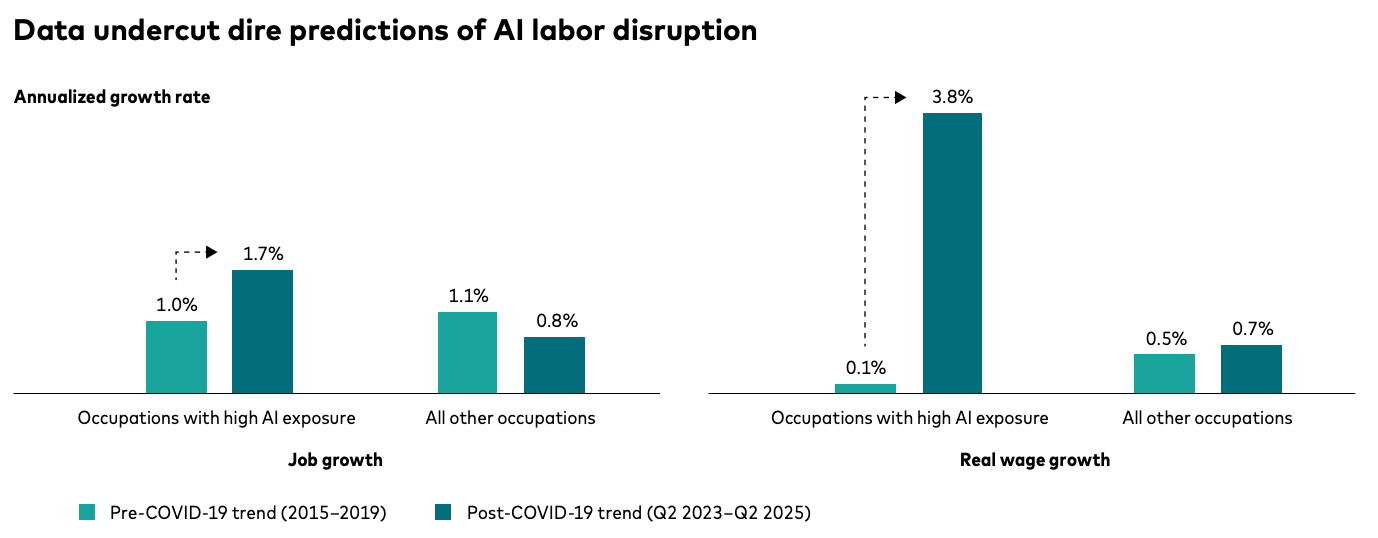
Occupations with higher AI exposure are seeing faster job growth and stronger real wage gains5
Research points to declining wage inequality and rising average wages6
Evidence suggests AI is raising the value of cognitive labor, not eroding it7
What does AI mean for productivity?
AI delivered a nearly $100B in consumer surplus in 2024 alone8
Users of AI report large productivity gains9
AI is improving business outcomes without causing large-scale labor displacement10
How has AI impacted economic growth in 2025?
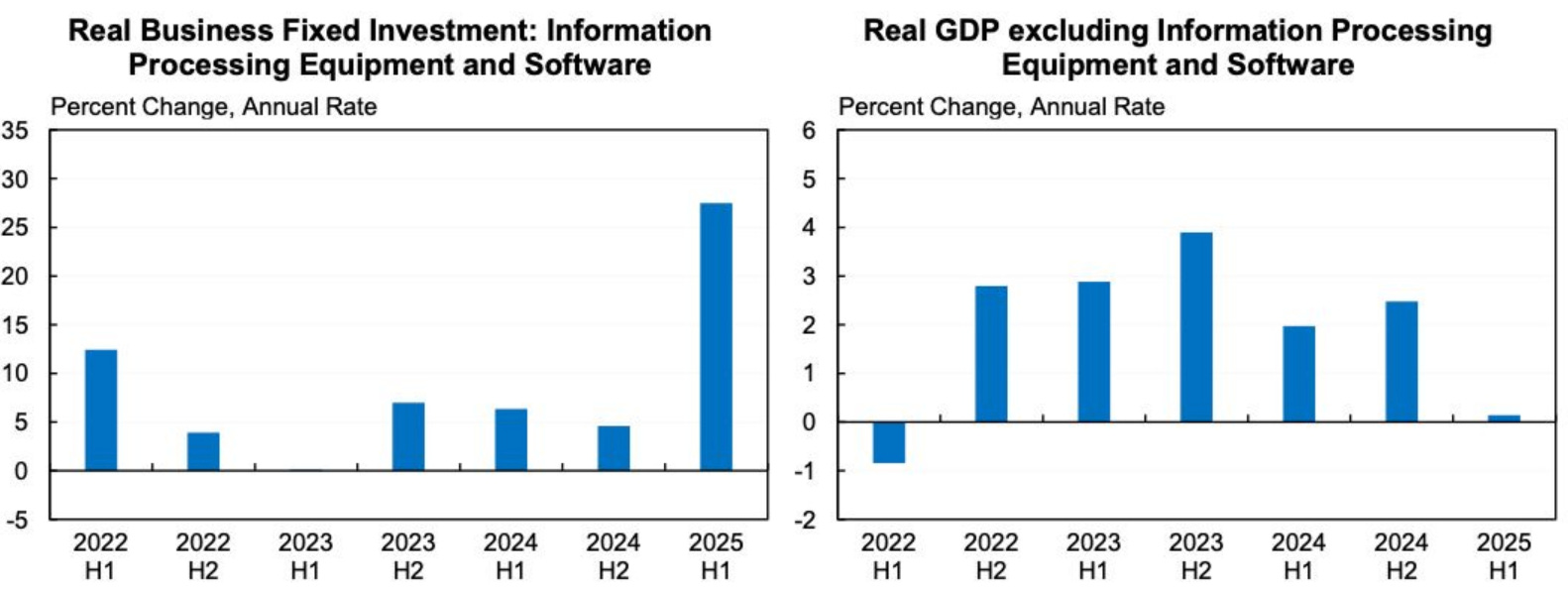
AI investments accounted for nearly all U.S. GDP growth in the first half of 202511
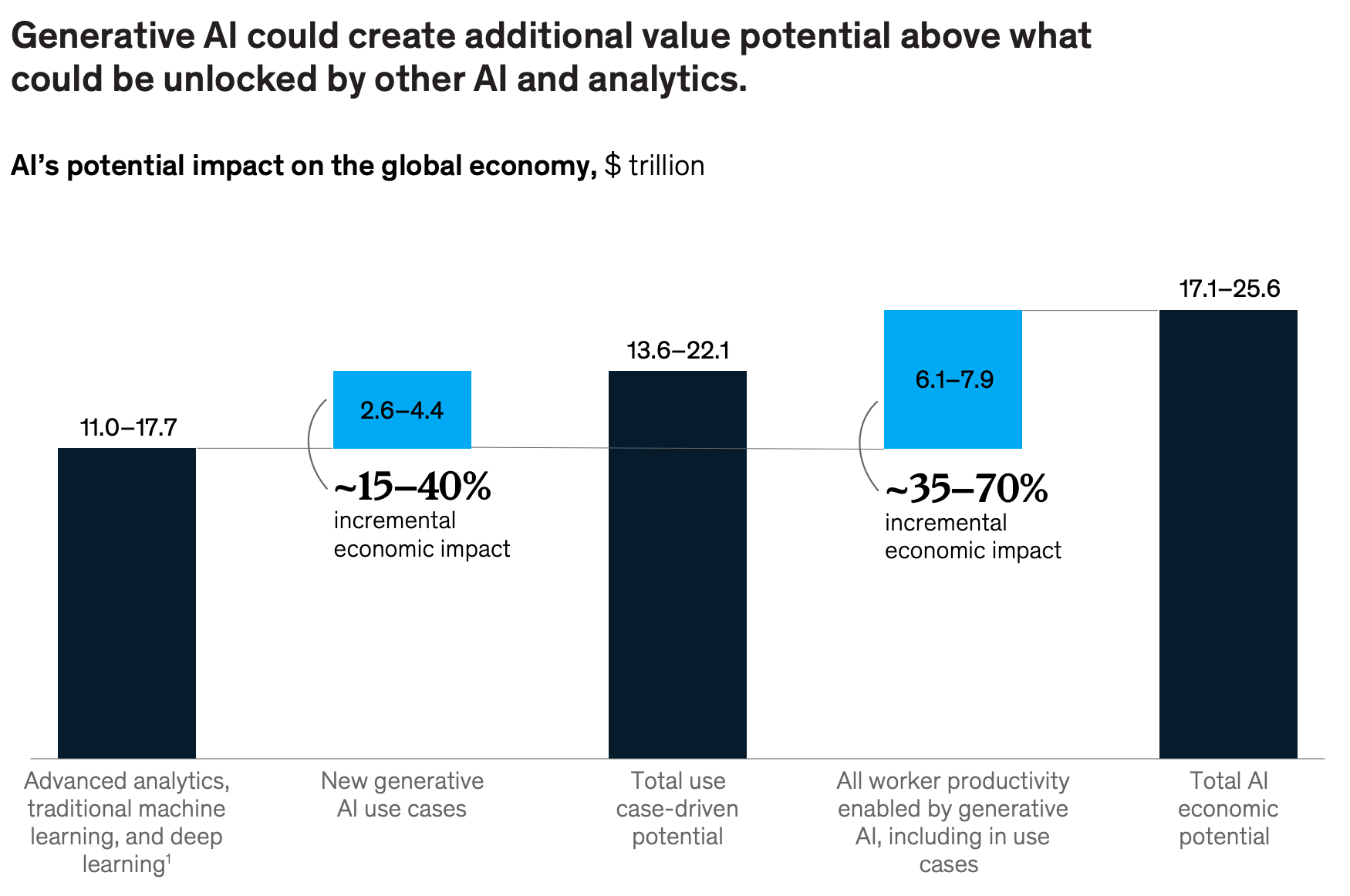
Leading estimates project trillions of dollars in additional GDP and productivity gains12
AI is reinforcing U.S. competitiveness by driving the economy’s growth13
Quotes
Stanford Research Paper: Althoff & Reichardt
A Stanford Professor’s research points to AI dramatically reducing inequality and increasing wages.14
“Our key finding is that AI substantially reduces wage inequality while raising average wages by 21 percent.”
Yale Budget Lab
Yale’s Budget Lab has closely monitored the effects of AI on the labor market.15
“Overall, our metrics indicate that the broader labor market has not experienced a discernible disruption since ChatGPT’s release 33 months ago, undercutting fears that AI automation is currently eroding the demand for cognitive labor across the economy.”
“Currently, measures of exposure, automation, and augmentation show no sign of being related to changes in employment or unemployment.”
“While this finding may contradict the most alarming headlines, it is not surprising given past precedents. Historically, widespread technological disruption in workplaces tends to occur over decades, rather than months or years.”
Stanford AI Researcher Erik Brynjolfsson
“Our research… widens the lens and finds that Americans already enjoyed roughly $97 billion in “consumer surplus” from generative AI tools in 2024 alone.”16
Oxford Job Study
“Anecdotal evidence suggests jobs are already being lost in sectors vulnerable to AI automation. Overall, though, firms don’t appear to be replacing workers with AI on a significant scale and we doubt that unemployment rates will be pushed up heavily by AI over the next few years.”17
Harvard Business Review
“In our in-progress research, we discovered that AI tools didn’t reduce work, they consistently intensified it.”18
The Dallas Fed
The Dallas Fed highlights that current data do not show AI causing massive labor displacement.19
“… the Current Population Survey data do not give much indication of widespread labor market disruption due to AI.”
Researchers from Stanford, Columbia and Pittsburgh
“AI-exposed jobs deteriorated before ChatGPT,” published in January 2026, dispels narratives about AI as the driving force behind higher unemployment rates for young workers.20
“… our results indicate that worsening labor-market outcomes in 2022–2024 for LLM-exposed workers and graduates were already underway prior to the mass-market emergence of LLM applications. Unemployment risk in highly exposed occupations rose beginning in early 2022— well before ChatGPT.”
Stanford Economist Jon Hartley and Others
“We also estimate the effects of Generative AI exposure on several labor market outcomes, finding small effects on wages in more exposed occupations since the November 2022 public release of ChatGPT while finding no significant effects in job openings or total jobs.”21
Charts
Additional Resources
“Task-Specific Technical Change and Comparative Advantage” by Lukas Althoff and Hugo Reichardt.
A research paper from Stanford on the wage impacts of AI. The authors find that “AI substantially reduces wage inequality while raising average wages by 21 percent.”
“Evaluating the Impact of AI on the Labor Market: Current State of Affairs” from the Yale Budget Lab.
A study from the Yale Budget Lab found that current job loss is not related to AI and occurred before the introduction of AI in the workforce.
“Young workers’ employment drops in occupations with high AI exposure” from the Dallas Fed.
A report from the Dallas Fed found that current data “do not give much indication of widespread labor market disruption due to AI.” They also found the decline in employment among young workers to be exceptionally small and unclear.
“AI exuberance: Economic upside, stock market downside” from Vanguard Research.
The Vanguard study shows that jobs with AI exposure are growing the most. Occupations with high AI exposure had a 1.7% job growth and a 3.8% real wage growth, greater than the growth before generative AI.
“AI’s Overlooked $97 Billion Contribution to the Economy” from Avinash Collis and Erik Brynjolfsson in the Wall Street Journal.
Two researchers published an op-ed in the Wall Street Journal that discusses a nearly $100 billion consumer surplus from generative AI tools in 2024 alone.
“More CEOs envision hiring than firing due to AI, CEO survey finds” in Axios.
A survey found that 55% of CEOs plan to hire more people in 2026 as a direct result of AI. Only 9% of CEOs said they plan to reduce headcount from AI.
“Generative AI could raise global GDP by 7%” from Goldman Sachs.
A report from Goldman Sachs states that AI could massively boost global GDP.
Jason Furman tweet on AI’s contribution to GDP.
Economist Jason Furman points out that the AI build out has accounted for a whopping 92% of GDP growth in the first half of 2025.
“The economic potential of generative AI” from McKinsey.
A report from McKinsey estimates the total AI economic potential to be between $17.1 to $25.6 trillion.
“Evidence of an AI-driven shakeup of job markets is patchy” from Oxford Economics.
An economics research study found that AI-driven job loss is “patchy.” Stating, “Anecdotal evidence suggests jobs are already being lost in sectors vulnerable to AI automation. Overall, though, firms don’t appear to be replacing workers with AI on a significant scale and we doubt that unemployment rates will be pushed up heavily by AI over the next few years.”
“The Simple Macroeconomics of AI” from Daron Acemoglu.
Nobel Prize Laureate Dr. Daron Acemoglu predicts a more modest impact of AI on both the economy and jobs, estimating only 5% of tasks will be automated by AI over the next 10 years.
“A new look at the economics of AI” from MIT Sloan.
The article explains Professor Daron Acemoglu’s “nontrivial, but modest” predictions on the impact of AI on GDP.
“AI Doesn’t Reduce Work—It Intensifies It” from Harvard Business Review.
An article from the Harvard Business Review found that "AI tools didn’t reduce work, they consistently intensified it.”
“‘Humans could go the way of horses’: Goldman calculated how bad the AI ‘job apocalypse’ will be—and its analysts were pleasantly surprised” from Fortune.
The article from Fortune discusses a Goldman Sachs report that found AI’s impact on jobs to be much more benign than expected.
“Is AI already driving U.S. growth?” from JP Morgan.
A report from JP Morgan discusses the impact of AI on economic growth.
“AI-exposed jobs deteriorated before ChatGPT” from a group of researchers.
This research paper, written by researchers from Stanford, Columbia, and Pittsburgh, dispels narratives about AI as the driving force behind higher unemployment rates for young workers.
“AI-powered growth: GenAI as a new engine of US economic performance” from EY Parthenon.
A report from EY shows that AI capital spending is driving GDP growth, there are no widespread, negative shifts in the labor market, and GDP cannot fully capture AI’s “true impact.”
“The Labor Market Effects of Generative Artificial Intelligence” from a group of researchers.
A study on AI on the labor market found that US workforce adoption of AI is around 40% and that there is “no significant effects in job openings or total jobs.”
“The AI Job Scare Needs Better Evidence” from AEI.
An article in AEI by James Pethokoukis highlights that the data does not show AI is causing mass job displacement.
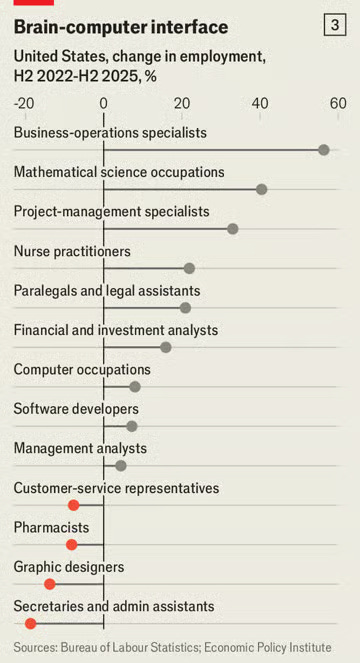
Why AI won’t wipe out white-collar jobs” from The Economist.
An article in The Economist shows that employment in most industries has actually increased since the release of ChatGPT.
“Why AI (Probably) Won’t Take Your Job” from Charles Fain Lehman in The Free Press.
A article written by a fellow at the Manhattan Institute disputes the AI job loss narrative with historical evidence and research from leading economists.